
The Holy Quran and the Environment
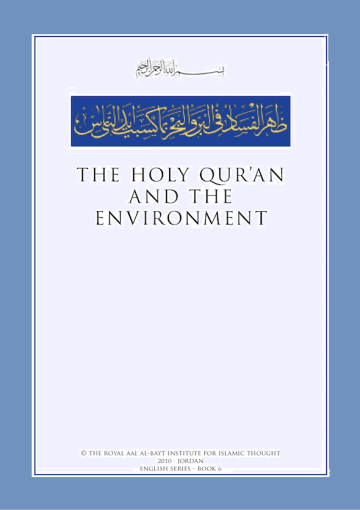
The Holy Quran and the Environment
Publication year :
2010
Publish location :
Jordan
Number of volumes :
1
Publish number :
First
(0 Votes)

(0 Votes)
The Holy Quran and the Environment
Environmental responsibility has become a major concern in contemporary religious and ethical discussions. Islamic scripture offers a perspective in which the natural world possesses meaning beyond its immediate usefulness to humanity. This study examines the relationship between Qur’anic teachings, respect for creation, and the responsibilities of human beings toward the environment.
About the Book
The Holy Quran and the Environment is a study by Ghazi bin Muhammad, Reza Shah-Kazemi, and Aftab Ahmed, associated with the Royal Aal al-Bayt Institute for Islamic Thought.
The work introduces the relationship between Islam and environmental ethics through four principal areas of discussion.
Its opening section examines the Qur’anic understanding of the natural world.
According to this perspective, God created the universe with truth and purpose.
The environment is therefore not presented merely as a collection of resources available for unrestricted human consumption.
Rather, the Qur’an describes elements of creation as signs pointing toward divine wisdom and power.
The study also emphasizes the Qur’anic teaching that creation praises God.
This idea provides a theological foundation for recognizing the significance of living beings and the wider natural order.
The authors argue that creatures possess inherent value within the divine scheme of creation.
Consequently, human beings have responsibilities toward other forms of life.
This understanding challenges approaches that evaluate nature exclusively according to economic or material benefit.
The relationship between humanity and the environment is presented as an ethical concern grounded in religious belief.
Respect for creation becomes connected with gratitude, restraint, and awareness of divine authority.
The study is particularly relevant to contemporary discussions concerning environmental degradation and the moral consequences of human activity.
It demonstrates how Qur’anic teachings can contribute to a religious understanding of ecological responsibility.
Rather than treating environmental protection as separate from spiritual life, the work presents care for creation as an expression of religious awareness.
Its contribution lies in connecting scriptural reflection with questions that affect both human societies and the natural world.
What You Will Discover
- The Qur’anic understanding of the natural environment.
- Creation as a sign of divine wisdom and power.
- The significance of nature's praise of God.
- The inherent value of living creatures.
- Human responsibilities toward other forms of life.
- Connections between Islamic ethics and environmental protection.
Who Is This Book For?
This study is suitable for researchers in environmental ethics, Islamic studies students, educators, and readers interested in religion and ecology. It is particularly useful for examining how Qur’anic teachings can inform contemporary discussions of conservation, sustainability, and respect for creation.


