
Millat Ibrahim (The Religion of Ibrahim)
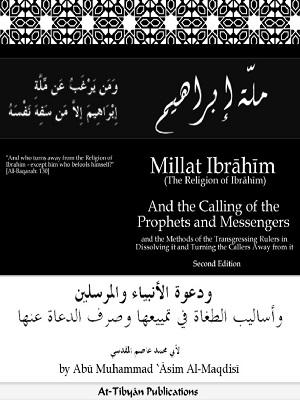
Millat Ibrahim (The Religion of Ibrahim)
Author :
Publisher :
(0 Votes)

(0 Votes)
Millat Ibrahim (The Religion of Ibrahim)
Abraham occupies a foundational position in Islamic monotheism as a prophet who rejected idolatry and affirmed exclusive devotion to God. His example has influenced theological discussions concerning religious loyalty and the rejection of false objects of worship. This book develops a particular political and doctrinal interpretation of that legacy.
About the Book
Millat Ibrahim (The Religion of Ibrahim) by Abu Muhammad al-Maqdisi examines the religious example of Abraham through the author's understanding of monotheism and contemporary political authority.
The work is associated with At-Tibyan Publications.
Its central argument draws parallels between idolatry in early Islamic history and political systems established through human legislation.
The author interprets certain forms of modern governance as violations of divine sovereignty.
This interpretation reflects a radical ideological position within contemporary Islamist thought.
It should not be treated as representative of Islamic theology as a whole.
The Qur’anic account of Abraham emphasizes his rejection of idol worship and his commitment to God.
Muslim scholars have interpreted this example in different theological, ethical, and political contexts.
Al-Maqdisi develops an interpretation that connects Abrahamic monotheism with opposition to political authorities he regards as illegitimate.
The book therefore extends beyond a conventional discussion of Abraham's prophetic biography.
It uses religious concepts to construct an argument about contemporary governance and religious identity.
An important feature of the work is its treatment of the relationship between divine authority and human legislation.
These subjects have been debated extensively within Islamic jurisprudence and political thought.
However, al-Maqdisi's conclusions belong to a specific extremist ideological tradition and are rejected by many Muslim scholars.
The text is significant as a primary source for studying modern jihadist ideological arguments.
Its analysis requires attention to the distinction between scriptural passages, established interpretive traditions, and the author's political applications of religious language.
For academic readers, this distinction is essential to understanding how religious concepts can be employed within radical political movements.
The work is therefore best approached critically and within its historical and ideological context.
Its principal research value lies in illustrating a particular interpretation of Abrahamic monotheism and its relationship to modern political extremism.
What You Will Discover
- Al-Maqdisi's interpretation of Abrahamic monotheism.
- The religious concept of rejecting idolatry.
- The author's comparison of historical and contemporary authority.
- Political applications of theological concepts.
- The relationship between divine sovereignty and legislation.
- A primary source for the critical study of jihadist ideology.
Who Is This Book For?
This book is primarily relevant to researchers in Islamic political thought, religious extremism, modern ideological movements, and contemporary security studies. It is particularly useful as a source for critical academic analysis of how religious narratives are interpreted within radical political frameworks.


